Happy New Year!


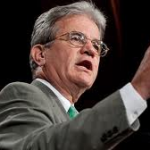
Senator Tom Coburn says raising taxes just means government gets to spend more.


Miles Zimmerman, longtime attorney and former district attorney in Pottawatomie and Lincoln Counties, has died at age 63.
Zimmerman was an OSBI agent before serving as district attorney for the 23rd Judicial District (Pottawatomie and Lincoln Counties) from 1991-1996.
He was in private practice in Chandler at the time of his death.
Services for Miles Zimmerman of Chandler will be Monday at the First Baptist Church in Chandler with burial at Parkland Cemetery.


Fox News
Chicago Police Superintendent Garry McCarthy says the city has logged its 500th homicide of the year.
McCarthy issued a statement Friday calling the milestone a “tragic number that is reflective of the gang violence and proliferation of illegal guns that have plagued some of our neighborhoods.”


In addition to higher federal taxes, Oklahomans face another threat to their pocketbooks from the fiscal cliff, State Treasurer Ken Miller said today.
“Taxpayers in Oklahoma save an average of 25 to 30 percent on interest costs by using tax-exempt bonds as a financing tool as opposed to taxable bonds, but that could go away thanks to fiscal cliff negotiations,” Miller said.
Miller said investors accept lower interest rates due to the tax exemption and that saves billions of dollars per year in lower taxes nationwide.
“Tax-exempt bonds are the primary mechanism that states, counties, cities and school districts across the country use to finance highways, streets, bridges, water systems, school buildings and buses and many other public infrastructure projects,” he said.
Miller said this critical tool is now in danger of being eliminated as Congress and the President consider plans to either eliminate it or place a cap of 28 percent on the amount of interest bond investors can deduct from their taxable incomes.
“While fiscal sanity is sorely needed in Washington, shifting the tax burden from federal taxpayers to state and local taxpayers will not resolve the spending problem our country faces,” he said.
“A rough estimate shows that Oklahoma state government would have to spend an additional $30 million each year if the interest paid on its tax-exempt bonds were to become taxable,” Miller said. “For counties, municipalities and school districts, the cost would be much higher.”
The tax-exempt bonds issued by the counties, cities and school districts are retired using property taxes. If the tax-exemption is capped or eliminated, interest rates paid to the bondholders would rise and so could property taxes.
Miller said another alternative would be a reduction in the capital improvement projects funded by tax-exempt bonds or cuts in funding to core areas.
“Neither of these are attractive options,” he said.
Tax-exempt municipal bonds benefit states and localities in the following ways:
• Local decision-making – States, counties, municipalities and school districts can build projects based on local priorities and needs assessments.
• Responsible financing – States, counties, municipalities and school districts can borrow responsibly for capital projects. Bond issuance has remained stable relative to GDP for the past 10 years.
• Private capital – Bonds bring private capital to public projects. In an age of constrained federal and state budgets, this is essential. More than 60 percent of bonds are owned by individuals, either directly or through mutual funds. To continue drawing this private investment, states and localities need tax-exempt bonds.
• Effective System – The tax-exempt bond market has worked effectively for decades. It’s not a loophole—the tax exemption was considered a fundamental right of states when the country adopted the 16th Amendment which allowed federal income taxes, and the principle that the income should be exempt was enshrined in the very first tax federal income tax code in 1913.
• Reciprocity – While the federal government provides a tax exemption on state and local bond interest, the states likewise do not tax the interest on federal bonds.
“As the debate continues on how to best avoid the fiscal cliff, Washington politicians should understand that any attempt to reduce or eliminate the tax exemption on state and local infrastructure financing would have serious repercussions,” Miller said.


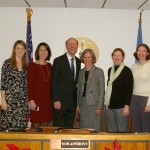
Corporation Commissioner Bob Anthony’s fifth consecutive six year term will begin January 14 and he’s shown here with his family after being sworn in today. Anthony has been a statewide elected official longer than any other current Oklahoma office holder. He has also served longer than any other current utility commissioner in the U.S. (Photo provided)


^NBC’s David Gregory’s liberal shoes are melting. He’s in hot water because he displayed a 30-round rifle magazine on television. It is against DC’s draconian gun ordinances for anyone to possess such a magazine. Somehow, it seems fitting that this moonbat now finds himself in this position; clearly an Obama booster who belittles conservatives and gun owners whenever possible, he sends his children to a private school where armed guards patrol the hallways. Yet he is dismissive of the NRA’s suggestion there should be armed guards in public schools. (And he’ll never mention that a former president also suggested armed school guards: Bill Clinton.)


Fox News
Classroom teachers could stop school shootings by carrying concealed weapons, say gun-rights advocates who plan to offer the required training Thursday for 200 Utah teachers.
The Utah Shooting Sports Council said it would waive its $50 fee for concealed-weapons training for the teachers. Instruction featuring plastic guns is set to begin at noon Thursday inside a conference room at Maverick Center, a hockey arena in the Salt Lake City suburb of West Valley.
It’s an idea gaining traction in the aftermath of the Connecticut school shooting. In Ohio, the Buckeye Firearms Association said it was launching a test program in tactical firearms training for 24 teachers initially.
“Schools are some of the safest places in the world, but I think teachers understand that something has changed — the sanctity of schools has changed,” said Clark Aposhian, one of Utah’s leading gun instructors. “Mass shootings may still be rare, but that doesn’t help you when the monster comes in.”
Gun-rights advocates say teachers can act more quickly than law enforcement in the critical first few minutes to protect children from the kind of shooting that left 20 children and six adults dead Dec. 14 at Sandy Hook Elementary School in Newtown, Conn. In Arizona, Attorney General Tom Horne has proposed amending state law to allow one educator in each school to carry a gun.
Educators say Utah legislators left them with no choice but to accept some guns in schools. State law forbids schools, districts or college campuses from trying to impose their own gun restrictions.
“We’re not suggesting that teachers roam the halls” for an armed intruder, said Aposhian, chairman of the Utah Shooting Sports Council, the state’s leading gun lobby. “They should lock down the classroom. But a gun is one more option if the shooter” breaks into a classroom.
A major emphasis of the safety training is that people facing deadly threats should announce they have a gun and retreat or take cover before trying to shoot, he said.
Utah is among few states that let people carry licensed concealed weapons into public schools without exception, the National Conference of State Legislatures says in a 2012 compendium of state gun laws.
Utah educators say they would ban guns if they could and have no way of knowing how many teachers are armed. Gun-rights advocates estimate that 1 percent of Utah teachers or 240 are licensed to carry concealed weapons. It’s not known how many pack guns at school.
“It’s a terrible idea,” said Carol Lear, a chief lawyer for the Utah Office of Education, who argues teachers could be overpowered for their guns or misfire or cause an accidental shooting. “It’s a horrible, terrible, no-good, rotten idea.”


Denver Media
A spike in requests for background checks on firearms buyers in Colorado has overwhelmed the system that businesses use to track how long the checks will take.
The Colorado Bureau of Investigation’s online wait-time clock for background checks tops out at 99 hours and 59 minutes. The Denver Post
reports the wait is now more than 100 hours, leaving potential buyers to guess on exact wait times.
The checks once took minutes, but request for background checks spiked after the school shooting in Newtown, Conn.